


Hello,
There’s really a sea change happening with AI and it only becomes real when you try it. Autonomous agents change work, it’s like everyone suddenly has to learn to manage a team.
PS: If you haven’t filled out my survey, I’d love to have your reader feedback.
Best, Martin

Generate 50-200+ enriched MQLs
every month.
Download the brochure ➛

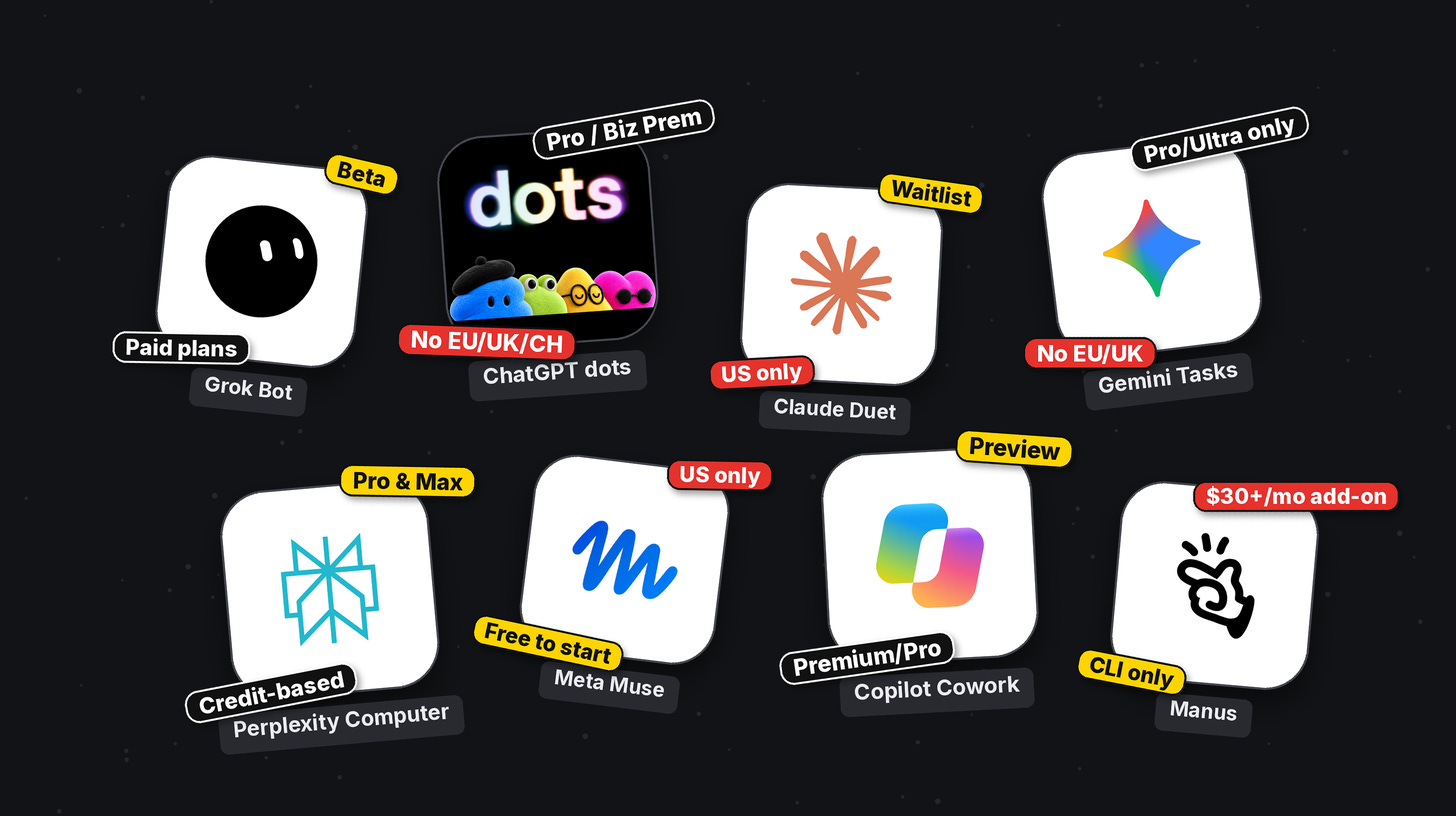
I think I was wrong about Agents
AI Agents are to AI what GPT was to the world before AI. But it takes experiencing them to understand that. Openclaw was cool if you liked to tinker with software tools. But for the rest of us, it was a weird science project.
After using Bots / Agents for a few weeks, I realize it will change how we work - completely. Think of them as expert team members that do complete work, very patient, and very willing to do the boring work nobody wants to do. They work until the task is complete. They are purpose driven and find solutions which they suggest if the first option didn’t work.
Today we can ask an AI to analyse our ads. But with Agents you tell it to run your ad campaign with the goal of increasing sales. And the bot logs in to the necessary places, tells you what data it needs, and then starts. Sending you a daily update with suggested changes in order to achieve the goals. Once you approve it implements them. If it has no API? no problem, it logs in and manages through the screen.
It is a totally different category of software. Generating text, images, HTML, and code is impressive, but giving twenty small autonomous workers actual goals and letting them figure out their way, that is something else.
I looked at some less obvious examples of what it could do for a hotel. Disclaimer, none of these are great ideas in terms of security and privacy. They’re here to illustrate what could be done.
Room assignments. Today, this is often done inside the PMS with limited logic, a lot of manual adjustment, and usually a front office team trying to remember who likes what. An agent could review arrivals every night, look at stay history, preferences, past complaints, room moves, loyalty status, housekeeping constraints, maintenance blocks, and even patterns the PMS does not really understand. It could then suggest room assignments and if you agree, it implements them on-screen. The PMS stores data. The agent could reason across it.
The night audit. Your PMS should already be doing this, but in case it doesn’t. An agent could run through the audit checklist at 2 a.m., compare payments against reservations, flag suspicious balances, identify failed charges, prepare manager notes, draft the morning report, and only escalate the unclear cases. Have it ready for the morning. Ask you a few questions, you answer and it completes.
Profile deduplication, nobody has time for this. You could ask an agent to analyze 300 possible duplicate profiles every night between 4 a.m. and morning. It would log in, compare names, emails, phone numbers, addresses, stays, transactions, notes, and loyalty data. If it is confident, it tags or merges according to rules, using the profile with the most stays or transactions as the master. If it is uncertain, it creates a review queue. You do not need to explain every rule or exception. It will figure them out and ask if unclear. Like a person would.
Guest Invoice requests, an agent could monitor the inbox for requests, identify the guest, search the PMS, find the stay, generate or retrieve the invoice, and draft or send the reply. If it cannot find the booking, it can ask the guest for the email they booked with or reservation details.
These are some ideas. As I said they’re not necessarily good one (privacy issues being what they are). Marketing has much safer use cases. But I wanted to take this out of the usual “generate a lot of ads for me” discussion to something more productive for hotels.
I don’t think this will replace people, I think this gives everyone super-powers that will make the whole team exponentially faster and more capable. It still requires humans to supervise the bots. But everyone has unlimited assistants now. It opens the question how much software do we need, if we can just get a bot to do the task? I’ll leave that one here.
So why was I wrong, because they’re incredibly competent. And it is possible they could solve problems when things go wrong on a trip.
About me: I'm a fractional CMO for large travel technology companies, and the co-founder of Pragmatik, an agency that drives MQLs through highly relevant content and distribution. You can find out more at wearepragmatik.com. Research With AI, Book With OTA
Booking.com’s Asia-Pacific chief told Skift she is fine with travelers starting in a chatbot as long as the booking closes on Booking.com. Their survey found 64% of travelers in the region use AI to plan, but traffic from AI is under 1% of room nights. Her explanation is that people hop between AIs before coming to Booking directly. Possibly true, and also a comfortable story for the company that sells the last step, and as the saying goes, slowly and then all of a sudden.
AI AND OTAS
Stop Saying Performance Marketing
Thomas Barta argues that both “performance marketing” and “brand marketing” are bad terms. The first implies other marketing doesn’t perform, the second that other marketing doesn’t build the brand. His fix is to call the first one direct response and accept that all marketing builds the brand and all of it has to perform. I need to update my scale of marketing.
BRAND VS PERFORMANCE + SCALE OF MARKETING
This is brilliant: Brand Is Arbitrage
Revolut CEO’s view that brand marketing is arbitrage i.e. the CPM online versus an airport billboard “CMP”. Performance clicks are measurable and therefore well priced, and arguably expensive, while logos in airports reach a lot of travellers for less. So one could technically do the math. What would it cost to reach them on Meta or Linkedin vs an out of home campaign. If the audience is somewhat relevant, the latter might be cheaper. But a lot less measurable…
BRAND AS ARBITRAGE
45 Minutes Per Room
The industry average for housekeeping is 22 minutes a room, and according to this article at Orient Express she watched a housekeeper take 45. Speed isn’t everything, in hotels and in any quality industry. Taking the time to care is underrated. Of course then there are those who “care” so much they never get anything done. But what if we looked at house-keeping as craftsmanship.
LUXURY HOUSEKEEPING
The growth of chains in Europe
Chains held more than 41% of Europe’s 6.5 million hotel rooms (not hotels) in August, up from 36% in 2020, according to CoStar. Marriott says hotels changing their sign were more than a third of its first-half signings, and Hilton and IHG have launched new collections that can capture European style boutique hotels. More distribution but cheaper?
EUROPEAN HOTEL BRANDS + GLOBAL HOTEL MARKET
Walmart Wants Your TV Budget
Walmart bought Vizio (low-cost TV brand) and Vibe.co (to run ads). At an event in New York, the head of Walmart Connect said these deals already give it “thousands” of relationships with brands that don’t sell anything at Walmart. Ads are big business. Hotel groups and OTAs are embedding this in their offering. How far until it is too far?
RETAIL MEDIA
Invisible to AI Agents
At the WTTC summit, Google’s Christie Travers-Smith warned that hotels risk becoming invisible to AI booking agents if they can’t give accurate information on amenities, prices and cancellation terms. The post adds that Wyndham’s CEO calls agents “a new type of guest” and feeds them rates and availability directly. None of this is new to you, but it counts for more when Google says it on a stage. But ARI is really the smallest problem. Ontologies are next.
AI VISIBILITY + HOTEL ONTOLOGY + AI HOTEL RECOMMENDATIONS
Your Regular Looks Like a New Guest
Booking.com’s top two Genius levels are just over 30% of its active customers and a high-50% share of its room nights. Every booking reaches the hotel under a new Guest email address, and since 28 September without a phone number, so a system that matches on email can file a returning regular as a first-time guest. Markus Busch suggests counting repeat guests by name and asking for the real email at the desk. Or you could launch a bot that de-duplicates at night.
OTA GUEST DATA
I would worry more if I was an OTA
Apparently Marriott’s CEO recently said he would worry more about AI if he were an OTA, because Marriott controls the stay. Very true. People still need to sleep in a bed. AI will not remove that. But will AI replace OTAs or just become another layer. I think it is more the latter. The OTA value will be in the data and AI planners can just plug into them. So more distribution? But is there more demand.
AI DISTRIBUTION + OTAS IRRELEVANT
Trip Planning Is a Feature
Interesting take on the AI Trip Planning market from Petr Syme. He argues it is just a feature and the OTAs will add it soon. Possibly. Or as I wrote above, do they just deliver the supply and let others take care of the rest. Hard to say today.
TRIP PLANNING IS A FEATURE + AI TRAVEL PLANNER LIST⁺
Reddit Loses Its Search Traffic
Reddit’s says search referral traffic fell meaningfully in the quarter, with the decline accelerating late on. They said if that continues the company’s total daily users could fall by a low double-digit percentage in Q4. It is one of the clearest company statements I have seen of what AI answers do to a site that lived on search. It isn’t time to panic, but it is time to take action.
AI SEARCH TRAFFIC
Instagram Wants the Living Room
Instagram is testing “Features”, horizontal videos of up to 90 minutes, first with creators in Brazil and now a small group in the US, and its TV app is now on Apple TV. YouTube went from 6% to 16% of TV time in five years and Instagram has 3 billion users. I read that as a prediction and not a result. Instagram is not sharing ad revenue with creators yet, which is a real gap with YouTube.
INSTAGRAM ON TV
• Apple Music Turns Sound Into a Logo - Link
• Torre Velasca Residences by Matteo Thun - Link
• Popular Art in the Age of Generative AI - Link
• Where Bang & Olufsen Began - Link
• A Walking-Stick Spy Camera at Auction - Link
Did you know: The word "autonomous" comes from the Greek word "autonomos," which means "having its own laws" or "self-governing." It combines "auto-" (self) and "nomos" (law or rule). The word entered English in the early 1800s, first used to describe independent states or regions, and later expanded to other uses. Defined using Lomar Dictionary⁺