


Hello,
AI buzzwords move fast. I skip a lot of them. But I think some of them are worth knowing about. As a shameless plug, I use Lomar Dictionary to get a basic understanding of them by putting the word and “(AI)” in the search bar, eg. Ontology (AI) it works great to give a simple definition without getting lost in wikipedia.
PS: If you haven’t filled out my survey, I’d love to have your reader feedback.
Best, Martin

Pragmatik builds high-converting
MQL engines through targeted content.
Just find out more ➛

Opinion
How hotels should prepare for AI
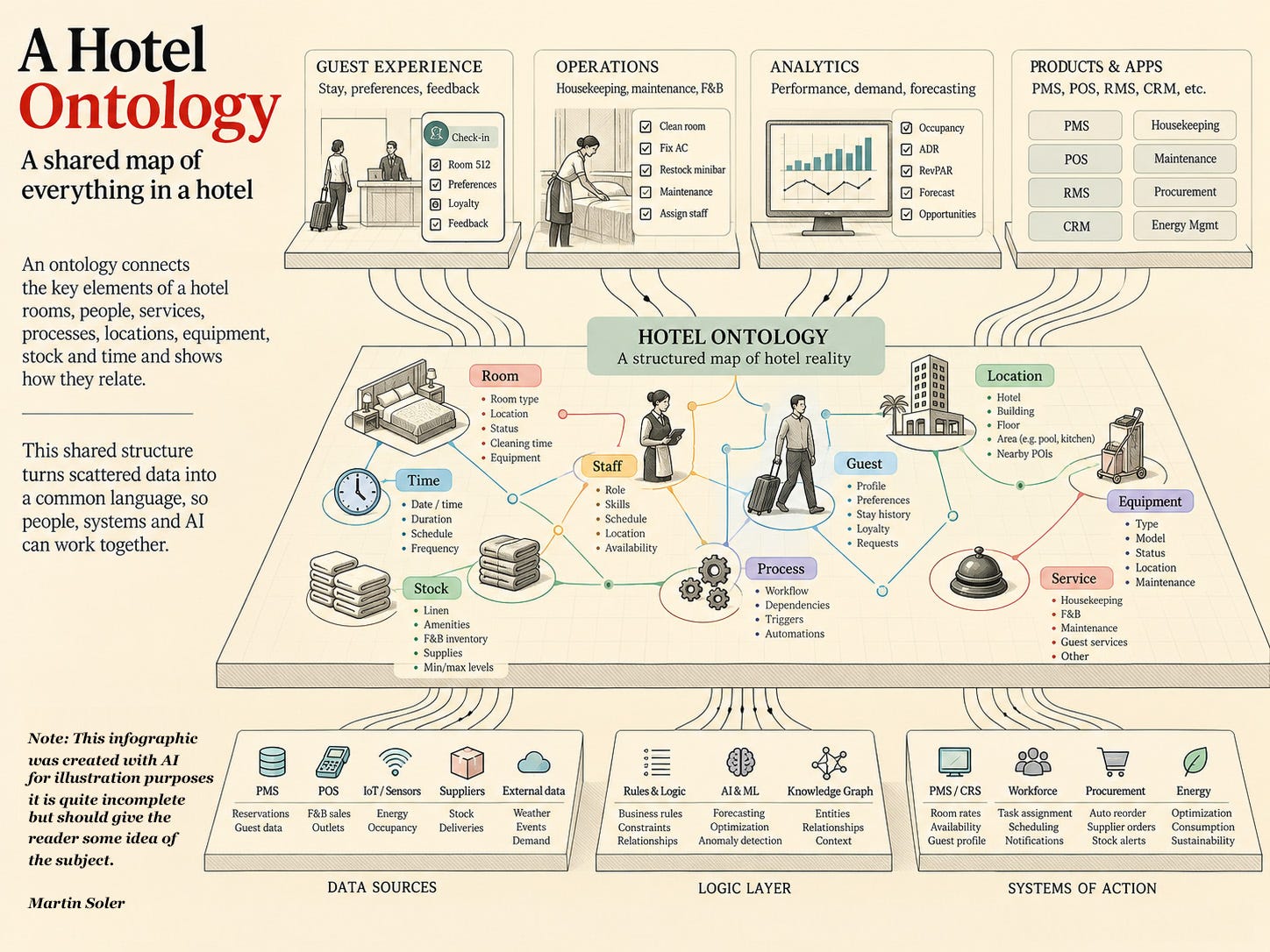
I recently wrote about preparing for AI that hotels should build the infrastructure to prepare for it. There is a layer to this that I think will become increasingly important: ontology. It’s the latest AI-buzzword so I figured let’s try to decrypt it for a hotel.
The word isn’t new, it comes from the Greek words “onto-” meaning “being” or “existence,” and “-logy” meaning “study of.” It was first used in philosophy to talk about the study of existence, and now used in AI to mean a structured way to describe knowledge.
The basic concept isn’t as complex as it sounds (someone building such system will accuse me of blasphemy here). For a hotel, it essentially is a description of what actually exists in the hotel, how those things relate to each other, and what can happen between them.
For example: Room 407. It is a Deluxe King. It can connect to 408. It normally takes 31 minutes to clean. The AC was repaired two weeks ago. The building plans know it is 75 metres from the main linen store.
Add to this the human knowledge. The executive housekeeper knows that 407 often takes longer because of its layout. The housekeeper knows the vacuum cleaner stored on that floor is terrible. Then add the SOPs on how to clean it, what products to use. etc. An ontology connects them so they’re not just a series of disrelated facts but facts related to objects, rules, SOPs etc.
This becomes particularly interesting for AI because AI needs context before it can meaningfully optimize anything. Take all SOPs, all floor-plans, approved products, etc. and then add to it dynamic data (stock levels, arrivals, departures, reservations, rates etc) you have an AI system that can start optimizing.
Perhaps the system discovers that housekeepers spend 18 minutes per shift walking back to get supplies. Perhaps it finds that certain room sequences consistently take longer because employees are moving between floors. Or that linen organization creates dozens of tiny delays every week.
If you’ve cleaned rooms you understand that saving two minutes per room is meaningful. But importantly, saving those two minutes by making a physically demanding job a tiny bit easier is better than telling them to clean two minutes faster.
Start thinking about ontology now. Not necessarily by buying an “ontology platform” or embarking on a three-year data project. Start small. List the important elements in your hotel: rooms, employees, tasks, equipment, and physical spaces. Identify which systems has which data that you might need. Gather the SOPs. Find out what is not documented and just “everybody knows”. Bring this together. Start structuring it with Claude, Gemini or whatever your AI of choice is.
And don’t collect everything simply because you can. A 40-room hotel probably doesn’t need centimeter-level tracking of everything.
My previous argument was that hotels need to build infrastructure so they are ready for whatever AI brings next. Gathering all this data and making it available for AI is a great place to start. It will tell a system how all the parts work together and then when you start feeding live data in there and you’ll probably get great insights.
And btw, a lot of that data can even help in AI discovery.
About me: I'm a fractional CMO for large travel technology companies, and the co-founder of Pragmatik, an agency that drives MQLs through highly relevant content and distribution. You can find out more at wearepragmatik.com. Avoiding the Crowds
Following last week’s column on tourism distribution, I was sent a link to Crowd Avoid it combines live crowd levels, weather, forecasts and alerts to help travelers visit attractions at quieter times. It is a nice example of technology solving the problem.
CROWD MANAGEMENT
Travel Advisors and AI
From another column where I noted that AI + Humans can build a whole new gig-economy, Fora is one of the companies building that (they started long before my post). There are several of these and I think this combo of AI + human can make travel much easier at a more affordable cost. Especially re-booking and fixing the problems.
TRAVEL TECHNOLOGY
Marriott Is Feeding the AI
Marriott CEO says the company is actively supplying content to AI platforms such as Google and OpenAI to make sure its hotels remain visible. Websites are for humans and the conflict has always existed between SEO (for machines) and design (for humans). With AI there might be two separate “websites” and smaller hotels need a practical way into that infrastructure too.
AI HOTEL DISCOVERY
Hotel TV and Streaming
Hotel TVs have become a weird large black square in the rooms. I don’t use them anymore. Neither do my kids. For years I’ve been saying we need to solve streaming on these TVs. So far it is still complex and not worth the hassle. Maybe something is going to change?
HOTEL STREAMING
Anatomy of a Great Ad
A high-performing ad doesn’t just get an initial burst of attention; it keeps converting as platforms push it from warm audiences into increasingly cold ones. The useful metric is whether CPA and ROAS remain stable while spend scales. That is a much better definition of good creative than likes or hook rates alone. The best advertising is ultimately creative that survives contact with a much larger audience.
AD CREATIVE

When Hotel Brands Become Merchandise
Bloomingdale’s is promoting Ritz-Carlton merchandise. To build a hotel brand that can be worn is quite a feat. Not many have achieved that but there are more than Ritz-Carlton that could pull it off. For a while I believe citizenM was one of them, more niche but if you knew, you knew. Loving how Ritz-Carlton have done this.
HOTEL MERCHANDISE
Autonomous Vehicles
I don’t know how much the travel industry is tracking Autonomous Vehicles. It is a niche thing that exists mostly in San Francisco and Austin. But once it starts to exist in cities like NY, London, Barcelona, Paris, Rome (good luck), etc. I think it will change a lot of the dynamics (including redistributing tourism). Fewer cars in cities, fewer cars parked in cities and a lot more.
COUNTING AUTONOMOUS VEHICLES
The History of GDS
Always great to look back at how things evolved. GDSs started as airline-owned technology but eventually became intermediaries charging airlines for access to their own distribution ecosystem. NDC was supposed to change some of that, yet it seems to have created more players rather than removing the toll booths (sounds familliar). AI may change the interface, but will it just add another connectivity layer?
TRAVEL DISTRIBUTION
Agentic Travel
There is a lot of excitement about agents booking complete trips, but the actual progress has been slower than the hype. Some people love travel research. Some hate it. The main issue IMO is going to be who handles disputes especially if going through an agent find a great price from 3 different vendors and the middle one goes wrong. As I mentioned above, human Travel Assistants have a real value here.
AGENTIC TRAVEL
Brand or Leads Is the Wrong Question
Marketing budgets are often divided between brand building and lead gen, but this argument is that the real problem is: what is actually constraining growth? If the problem is awareness, spend should create audience; if it is trust, more performance advertising probably won’t fix it; and if it is conversion, brand reach may not be the immediate priority. There is no “best practice” that solves everything. It does require a proper analysis and identifying the biggest problem.
MARKETING CONSTRAINTS
Travelers and Age
Travel spending changes dramatically across life stages, apparently Americans aged 55+ are responsible for almost half of travel spending. But marketing focuses on the younger travelers. This could be aspirational (most people want to go where the cool kids go). As I’ve said before segmentation around life stage and travel purpose probably tells us much more than GenZ, Millenials etc etc.
TRAVELER LIFE STAGES
• The Morning Meeting With Memory - Link
• Where to get inspiration for hospitality - Link⁺
• Brazilian Design at the Airport - Link
• The Hotel Yearbook Goes All-In on AI - Link
• Beyond the Annual Tech Budget - Link⁺
Did you know: In Philosophy, Ontology means The study or theory of the nature of being, existence, or reality, and the basic categories of things that exist and how they relate to each other. Defined using Lomar Dictionary⁺