


Hello,
I find we have entered an amazing era for Hotel B2B technology. The inherent structure of business technology means we should be able to automate more and AI will help. The integrations and security complexities are opportunities and moats. Exciting times ahead.
And now, here’s the newsletter. Have a great week.
Best, Martin
PS: If you think of someone who would benefit of this newsletter - send it to them and have them sign-up.


Klairhaus is a boutique brand of home office accessories crafted by artisans in Europe with a generational heritage of quality both in materials and manufacturing. Using only natural materials, discover accessories designed to make your work life better.
Support the newsletter, treat yourself to great office gadgets.
Finding your narrative
In working on hotel marketing, I used to call this finding the USP of the hotel. I had made quite some work on that, breaking down the process and teaching it. April Dunford has done an excellent job at figuring this out for a B2B tech company and structuring this. She calls it positioning, which is not bad but a little confusing as positioning already existed as a term and was slightly different. Basically she explains that for B2B companies, effectively positioning solutions against competitors requires a deep understanding of the buyer's perspective. She correctly points out that demonstrating differentiated value and reducing the pain of change are key to winning business. Totally worth reading for B2B sales and marketing, including hotels who want to sign corporate customers.
BUYER-CENTRIC STRATEGIES
The new Search
In the U.S. Google Search has taken a significant leap by incorporating generative AI through its new Gemini model, aiming to simplify the search process by providing quick and reliable information, as well as assisting with tasks like research and planning. The AI Overviews feature has plans to expand globally and potentially reach over a billion users by the end of the year (but the EU will probably be missing out). The integration of such AI in search will change search, making it more personalized and efficient for booking, as we can refine search. But will this be good for direct? Or will the OTAs take it? Could the hospitality industry leverage this AI to improve direct bookings and guest interactions?
SEARCH EVOLUTION GOOGLE
But experiences aren’t new
A recent McKinsey study discusses the potential market size of experiences. While it seems like this is a whole new market, it has always existed. But it has never really been structured. The structuring of the industry (bundling) is a large opportunity as it will become easier to buy, create them, sell experiences. Instead of having large racks of flyers in hotel receptions, of varying quality and relevance, hoteliers will be able to integrate the experiences that fit with their brand standards and sell those through their website, in-room entertainment, apps, etc. And have a better approach to selling their on-site experiences.
EVOLVING ROLE OF EXPERIENCES
About me: I'm a fractional CMO for large travel technology companies helping turn them into industry leaders. I'm also the co-founder of 10minutes.news a hotel news media that is unsensational, factual and keeps hoteliers updated on the industry. Corporate Travel’s tech awakening
Amazon tops the 2024 Corporate Travel 100 list, with companies like PwC, Walmart, and Deloitte increasing their travel spend and focusing on technology to improve budget efficiency and traveler experience. However, Deloitte which was #1 in 2019 but is #2 in 2024, is spending half of the money they were spending in 2019. The interesting part is how technology is becoming the cornerstone of the corporate travel experience. As it is also the most rules-based travel booking process, this is the one that potentially can get the most AI and automation included in it, making it faster and easier. But will it become more profitable?
CORPORATE TRAVEL TRENDS
Brand Consistency over Star Ratings?
Maintaining a consistent brand identity is the hardest thing with hotels, products age. Reinvesting wasn’t part of the plan. etc. But it seems brand consistency potentially has a greater impact on customer loyalty and market share than star classification or chain scale. A 2018 study by Cornell University underscores this point. The disparity of brand standards isn’t easily solved. Unlike an iPhones, we’re not shipping a new edition of all hotels every September. Yet the Hilton Fumicino and the Hilton Paris Opera are so different it makes little sense to keep them with the same brand.
HOTEL BRAND IDENTITY
Podcast: I was invited on the Hospitality Daily Podcast and spoke about technology in hospitality, some thoughts on what wont change in hospitality, and why I co-founded 10minutes.news. Best, MartinTHOUGHTS:
Is Hotel Analytics reaching the Plateau of Productivity?
It seems the hotel industry is starting to get serious about hotel analytics and business intelligence. Refer to the Hype Cycle.
Last week 3 new announcements were made of hotel analytics solutions, several seem to be management companies internal tools that are being productized. Competition is growing and that's a good thing.
10 years ago, I was part of a startup that launched one of the first broadly available hotel analytics tools. The market was interested but things were not ready, too early is almost as bad as too late.
Some things I learned from Analytics tools.
DYI design solutions like PowerBI and Tableau are great - but they quickly become an unreadable mess of random charts.
On the other hand, pre-designed tools get quick adoption but rapidly require infinite customization.
Standardizing cut-off times, currencies, systems is not as easy as it sounds.
"Excel Killer" is a mission statement nobody wants, but the people making the product.
Getting a BI solution is a no-brainer. But going from Excel (which seems free) to a paid solution is not as easy as it seems on paper.
Middle-management needs to be able to control and adjust figures or they will kill the solution.
The best use of pie-charts is to decorate a dashboard, it adds a lot of color and fills blank space well, but mostly it is unreadable.
Design your dashboard as you would tell a story of the hotel. The charts should logically lead to one another and tell the story of what is happening in the hotel/business.
The ideal dashboard shows the manager exactly where they need to focus their attention to deliver the best Return on Effort.
Nobody wants to hear this but a well designed morning dashboard/report on email delivered per stake-holder is one of the most valuable features to build. And helps with product retention rate.
Looking forward to seeing hotel analytics really go mainstream and let's see who managed to integrate the most complete data. Imagine all the automations, and AI solutions we'll be able to figure out when we have them integrated.
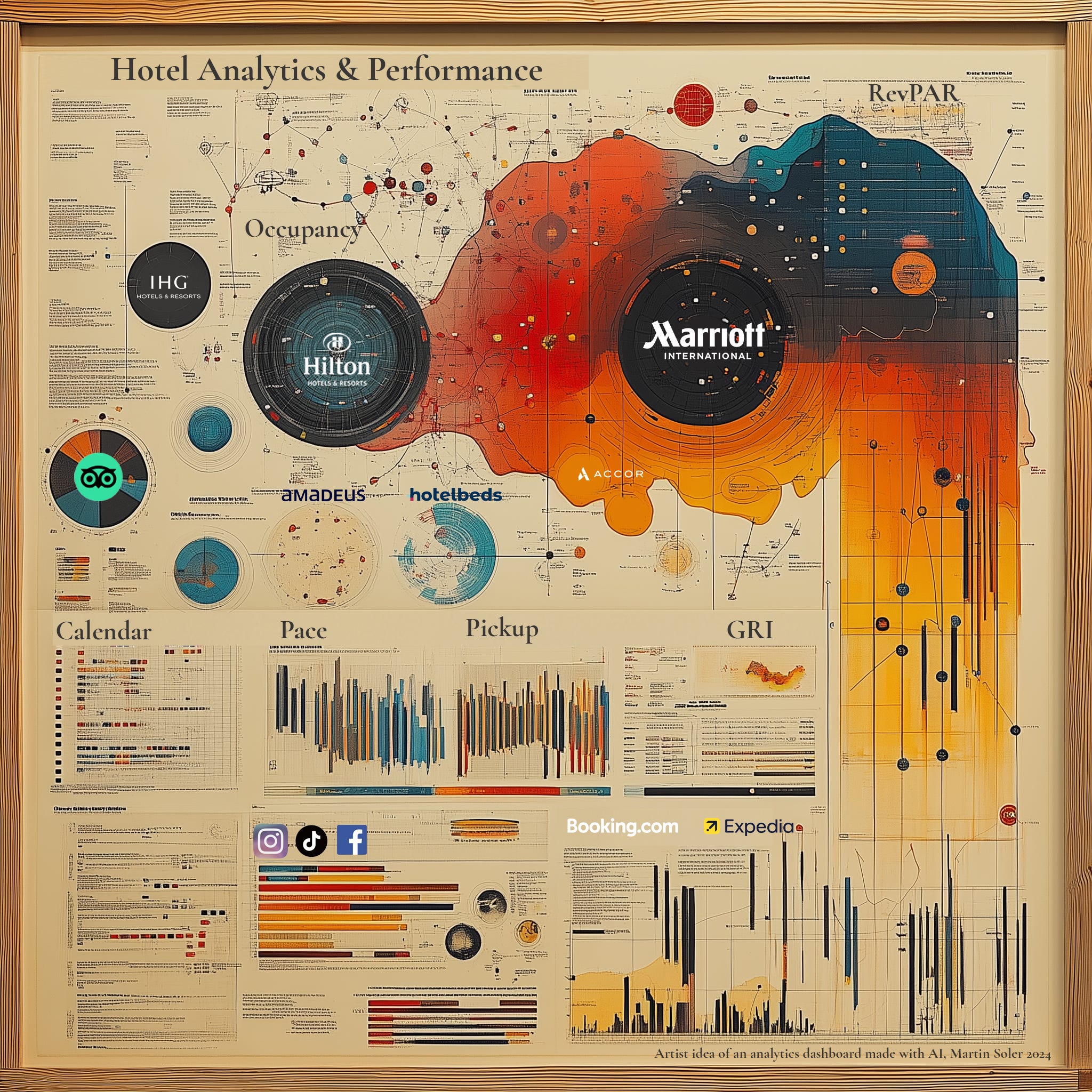
Image is an AI made artistic hotel analytics dashboard I wished existed. I love it when they're interesting to view.
See the original post and comments
