


Hello,
OpenAI released a big dataset on how people use ChatGPT. There’s sadly not much travel in it, but there’s enough to think about who you could actually reach with ads. See my column below.
PS: If you haven’t filled out my survey, I’d love to have your reader feedback.
Best, Martin

Generate 50-200+ enriched MQLs
every month.
Download the brochure ➛

Finding your guests in the ChatGPT data
I spent some time going through the data dump OpenAI published about how people use ChatGPT (they call it Signals). I was hoping for a travel section. There isn’t one. There’s no travel category, no destinations and nothing on hotels. It’s higher level than that, which is a pity.
So the first thing to say is that whenever you see “X% of ChatGPT is travel” in the coming weeks, it’s a guess. Maybe an educated one, but a guess.
What the data does show is intent: what people are trying to do when they open it. I focused on one group, people seeking information, because I think they’re the ones most likely to be planning something, a trip included. Seeking information is now about 20% of all messages, up from 16.7% in July 2024. About three quarters of it has nothing to do with work (apparently a lot of people are “expressing” themselves to ChatGPT, I have opinions on that).
Anyhow, I asked three questions, the same ones you’d ask before opening a shop on a new street. Who walks by? What are they looking for? And can I actually put a sign in front of them? I made some charts to visualize them better:
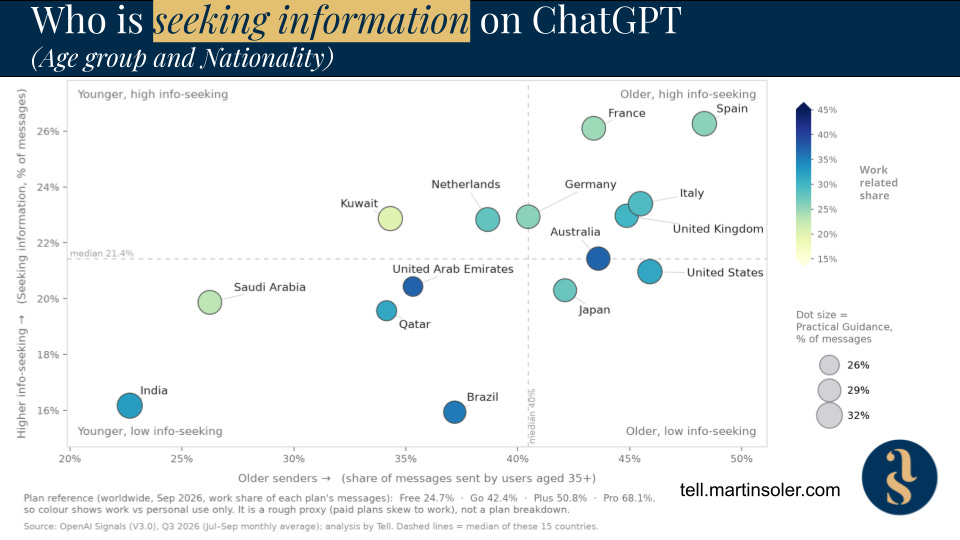
Where are they? The share of info-seeking varies a lot by country. In Q3, Spain (26.3%) and France (26.1%) led the big markets, ahead of the UK (23.0%), Germany (22.9%) and the US (21.0%). India and Brazil are down around 16%. You can see the quadrant chart in the hero image above.
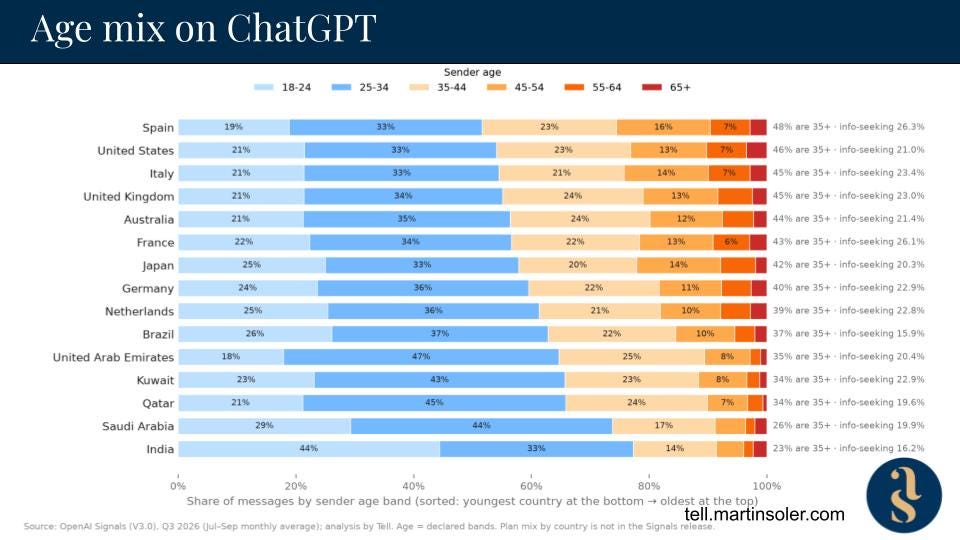
How old are they? Info-seeking rises with age. It’s 18.1% of messages from 18–24 year olds against 25.2% for 55–64 year olds. So the older users are the ones asking.
Which plan are they on? This is the one that matters for ads, because only two plans show them: Free and Go (the $8 one). Plus and Pro don’t. And this is where the data goes quiet. There’s no breakdown of how many people are on each plan, by country or otherwise. All we know is that Free is the most personal use (about 75% non-work) and Pro the least (68% work).
Let’s take an example. Say your hotel is in Paris and most of your guests are American. 46% of US ChatGPT messages come from people aged 35 and over, which I’d assume is roughly the group that can afford a high-end hotel in a big European city. About 21% of US messages are seeking information. So far, so good.
But how many of them are on a free account? We don’t know. And I wonder: if someone has the money for a high-end hotel in Paris, are they using the free version? Or are they paying $20 a month and never seeing an ad? Maybe the free user with money is more common than we think, since plenty of people don’t pay for software they use casually. I honestly don’t know. That’s food for thought.
So should you invest in Chat GPT ads?
I don’t think we can reason our way to an answer, the data wont tell us. At this point I would recommend to test: a small test with a leisure segment in one or two source markets, measured with the usual caveats. But it’s early so don’t expect miracles, expect to learn.
Before that, go through the numbers yourself. The data is public. Take your top three or four source markets, look at the age mix and how much of their usage is info-seeking, and check whether your guests even look like the typical ChatGPT user there. A hotel in Seville with mostly German guests in their fifties will see a very different picture than a hostel in Lisbon full of 25-year-olds.
It doesn’t give all the answers, but it gives something, and that’s more than we had before.
About me: I'm a fractional CMO for large travel technology companies, and the co-founder of Pragmatik, an agency that drives MQLs through highly relevant content and distribution. You can find out more at wearepragmatik.com. Agents vs Marketplaces
Dan Hockenmaier looks at Amazon blocking shopping agents and argues Amazon is safer than people think, thanks to logistics, returns and trust. The interesting part for us is that he says hotel-booking marketplaces are more exposed, because an agent can book directly with the hotel. I wonder how many hotels are actually ready to be booked that way.
AGENTS VS MARKETPLACES + RETAIL AGENT MATH
Meta’s Muse Goes to Japan
Meta’s Muse agent launched in Japan, its first market outside North America, with Trip.com, Agoda, Stripe and Shopify as integrations. Klook supplies 426,000 experiences, and with the user’s approval Muse places the order, sends payment to Klook and saves the booking in the chat. Expedia has announced an integration too. I don’t see any hotel brands in that list, which is worth watching. Muse is turning into an AI travel assistant.
AGENTIC BOOKING
The Map of AI + Travel
Tony Carne, who writes the Everything AI in Travel newsletter, published a map of 171 companies using AI to build for travel, as of 21 October. If you do research in this space, open the full landscape, find your corner of it and see who is building there. It will keep changing, so subscribe to his newsletter to stay on top of it. The consumer slice (25 companies, mostly trip planning) is a good companion to last week’s AI travel planners piece.
AI TRAVEL LANDSCAPE + AI TRIP PLANNERS
Tesco, the Media Company
Tesco now has more than 2,800 advertising screens in its stores, and some will soon show influencer videos. They also announced a self-serve ad platform. Can this expand to hotels? how frustrating will that be to guests?
RETAIL MEDIA
Strategy by Simulation
If we all test our strategies on AI simulations, we may simply reach the same answer faster. In the article there’s a Bocconi research where model responses sometimes varied less than half of human responses. But I suspect the idea that is too new or different might not test well, and that is often the one worth doing.
AI AND STRATEGY
AI Adoption vs ROI, Again
A survey found 47.8% of marketing teams have replaced human tasks with AI in the past year, but only 6.5% measure the ROI. That sounds familiar. The recent h2c study I shared had hotel AI adoption at 91% and only 13% reporting measurable returns. Using it is the easy part, knowing what it did is harder.
AI MARKETING ROI
Hotel Merch, Done Expensively
Designer Kim Jones launched a resortwear collection with Aman Essentials after 18 months of work. It was inspired by his stays at about 30 Aman properties and includes silk pyjamas, swimwear and eveningwear. Hotel merchandise is usually a tote bag. This is a brand extension that guests might actually want to wear, different from Ritz-Carlton, but similar.
BRAND EXTENSION
Ultra-Luxury Is the Safer Bet?
JLL counts 59 hotels worldwide with an average daily rate above $3,000, up from none in 2019. Apparently scarce ultra-luxury hotels are a clearer investment than AI travel startups. Scarce sites, long approvals and high costs keep supply tight. It’s an investor’s view, but I like it as a counterweight to all the AI noise. Not everything is about agents. A side note however is that the most profitable hotels aren’t the ultra-luxury ones.
ULTRA LUXURY INVESTING
Would You Pay for Loyalty?
Accor’s paid loyalty programme in Asia Pacific, ALL Accor Plus Explorer, has over 485,000 members who booked more than 3.8 million room nights in the past year. Annual fees in Singapore, Australia, India and Japan range from $244 to $259. Accor sees it as a revenue driver of its own. As I said last week about Amazon Prime, loyalty works best when people pay to be more loyal and the benefits are worth it.
PAID LOYALTY
The Goodbye Guests Remember
Hotel Nuggets shares four ideas. Among them: a bakery that doubles as the lobby and reception, a Mickey Mouse statue that points to the toilets, and a hotel that handed out two unsolicited water bottles at checkout. None of this needs technology, and all of it is cheap. The Mickey “signage” is brilliant. And all of these are low-tech (well a backery isn’t a simple thing to do).
HOTEL IDEAS
When AI Sends Guests to a Broken Page
AGR found AI recommendations repeating website errors. One West Hollywood hotel referenced Nashville, and a Rosewood in Mexico promoted a closed restaurant. Hotel or brand sites are cited in 31.6% of ChatGPT answers, so the page the guest lands on matters. This is where I think hotel websites will split into two, one for humans and one for AI bots. The latter will just be a lot of code that is frequently updated.
AI REFERRAL AUDIT
Gmail’s AI Skips Your Newsletter
Google’s paid AI Inbox, rolled out in the US in English on 12 October, reads only the Primary tab and skips Promotions and Social. Hotel confirmations may show up in its briefings, but newsletters won’t. Markus Busch suggests keeping booking details first and offers second, so the email stays transactional. I can guess where newsletters like this one end up.
EMAIL AND AI
• Visit Iceland Sends a Knitter to Your Meeting - Link
• Where to get inspiration for hospitality - Link⁺
• Prada Draws Its Holiday Campaign by Hand - Link
• Hospitality in the Mirror - Link
• The Geometry of Coral, Up Close - Link
Did you know: The word "seek" comes from Old English "sēcan," which means "to go to, look for, or search." It is related to Old High German "suochen" and Latin "sequi," meaning "to follow." Over time, it kept the meaning of looking for or trying to get something. Defined using Lomar Dictionary⁺