


Hello,
This week, lots of discussions about distribution, where is AI going to move it. We’re in an odd “everything is fine” moment. But it time to prepare for what’s next.
PS: If you haven’t filled out my survey, I’d love to have your reader feedback.
Best, Martin

Pragmatik builds high-converting
MQL engines through targeted content.
Find out more ➛

Opinion
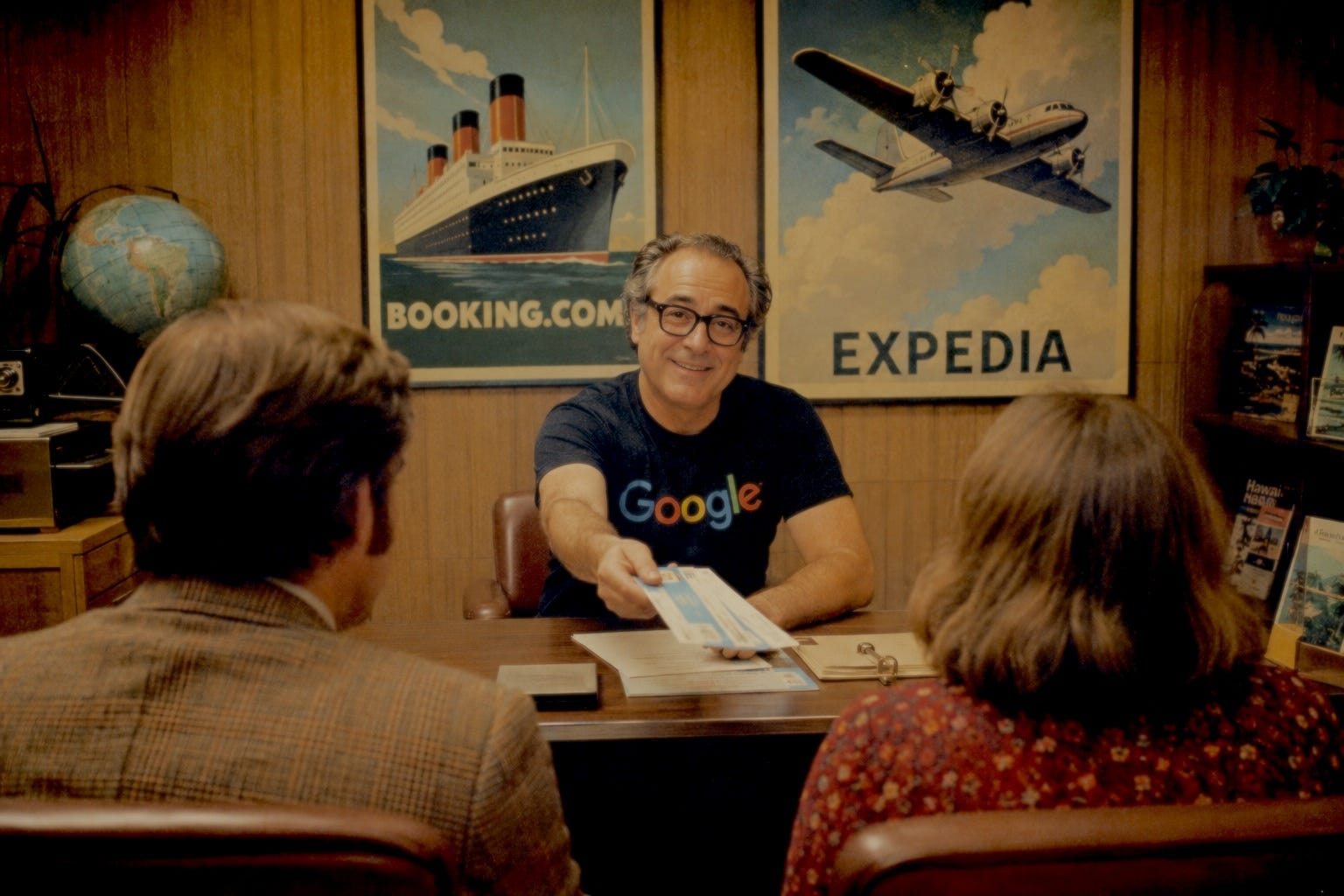
Who will control choice in Distribution?
There is a reassuring narrative around search/distribution right now. Google is doing fine (stock is 68% up on 12 month and Booking is recovering), apparently hasn’t been a dramatic migration from search to AI. But we all know, discovery is changing.
Google is navigating this well for an incumbent. Its AI isn’t necessarily the most hyped. While others battle for the number one position, Google seems quite comfortable.
So perhaps the question isn’t whether AI kills Google Search. It is who controls the moment of choice.
For years, travel companies paid Google to be found. Search produced options, customers clicked, and hotels or OTAs converted them. AI changes that because it can increasingly do the narrowing down itself. Instead of showing me 200 hotels and some filters, it can understand what I want, compare the options and give me three. General visibility matters less if someone else controls the shortlist.
This brings me back to what I wrote earlier this year about OTAs. They still have some of the strongest cards in travel: structured inventory, rates and availability, payments, customer service and trust. But their core discovery experience of search, filter, sort and scroll increasingly looks like something AI can do better.
So unless OTA search becomes vastly better than the general AI platforms, why would consumers develop another habit? A chatbot probably isn’t enough. Full itinerary orchestration might be. Booking the flight, hotel and transfers, then dealing with changes, cancellations, refunds and the angry customer at 2am is genuinely valuable. AI platforms may want the customer interface without wanting that mess.
But OTAs might become just plumbing. Providing inventory, ARI, payments, support and transaction infrastructure while AI owns the interface and becomes the new metasearch. There is even the outlier scenario I still like, where AI creates affordable human travel assistants, people using AI to manage your entire trip on your behalf.
I don’t think we know which model wins. We may even develop separate AI verticals, as we did with search: Amazon for products, Booking for travel, Google for general questions. But currently the trend is that experiences seem to be converging.
For hotels, predicting the winner is probably less useful than identifying what doesn’t change. Recognizable brand, lots of contextual data, accurate and good photography, inventory, pricing strategy, connectivity, strong reviews remain valuable whichever interface wins.
Discovery is shifting first. Distribution will probably shift later. What will matter most in the discovery/distribution debate is who suggests choice. That part is still a moving target. But if hotels and brands focus on what determines choice (instead of who) and ensure those foundations are strong they have a chance.
About me: I'm a fractional CMO for large travel technology companies, and the co-founder of Pragmatik, an agency that drives MQLs through highly relevant content and distribution. You can find out more at wearepragmatik.com. ChatGPT’s Restaurant Move
ChatGPT launched a native restaurant experience apparently the steak recommendation wasn’t amazing, but if ChatGPT can move from recommending restaurants to comparing, choosing and eventually completing the transaction, it starts looking a lot more like a super app. Restaurant is less risk than Hotel, but great place to test.
AGENTIC DINING
Who Controls the Moment of Choice?
As I mentioned in my column (inspired from this). The next battle in media is over who controls the moment when someone decides what to consume. The argument that it isn’t just distribution, but coordination is relevant for the travel industry. Even more when one starts to package things up. Search engines, OTAs and now AI assistants increasingly sit directly in front of the customer at the point where choices are being narrowed down. Its a nuance on distribution, this one is about media, but I think it applied to all online commerce.
CHOICE CONTROL
When Nobody Seems in Charge
You can sometimes walk into a business and know that all decisions happen elsewhere. I recall a BofA I went to, spent 4 hours in and nobody in the branch was capable of making a decision. Rigid processes and layers of approval killed the human touch. Hospitality needs standards, but it also needs people who can react to situations in front of them. This is where people matter. As I wrote last week, trust.
HOTEL LEADERSHIP
Booking.com in AI, but clicks?
Booking.com is apparently showing up more frequently in AI search while referral traffic from those systems remains tiny. CFO says, AI isn’t impacting them much. As I wrote above, we’re in the “business as usual phase”. But in the real world we know that most research happens in AI, don’t we?
AI REFERRAL TRAFFIC
295 Million Bonvoy Members
296 million is an enormous audience. But let’s not forget that these members are being paid to be members, they’re not paying to be members, this changes many things. Marriott says 68% room nights from members, but that’s an easy number to fix, free wifi in the hotel requires being a member. Members don’t need to book direct. Still - retail media could be a big revenue source. And let’s not forget this is their main consumer product.
HOTEL LOYALTY

AI Makes Performance a Commodity
As everyone gets access to great AI marketing tools, performance advantages become easier to copy. Brand building becomes the one asset that can’t really be replaced. Because one cannot easily manufacture years of memory, associations and trust. The performance vs brand debate is tiring, but funny that AI will likely make brand more important again.
BRAND ADVANTAGE
AI for the Calls Nobody Answers
The problem with AI calls is when it is being used to solve the edge cases. Because that’s when AI usually fails (it is built on the averages). However when it can be used for things like late calls. Or answering easy questions when the phone is busy I think everyone will be happy. Even just to take a room order, convert it to a message to the right person.
AI BOOKING SUPPORT
The 500-Follower Influencer
Brands putting more influencer budget behind ordinary creators with very small audiences makes sense in an algorithmic feed that does its own distribution. Still so many people still think in terms of demographics, and channel reach etc. Most distribution is algorithmic now, that means the channel is less important than the content.
MICRO CREATORS
AI Builders don’t know everything
Sergey Brin discussed frontier AI in a rare unscripted Q&A and acknowledged some of the uncertainty surrounding the systems being built. Many consultants seem to be experts in AI. But all new tech introduces change and knowing that we don’t know where and how it will evolve is probably the best forecast today.
FRONTIER AI
Retail media in your BMW
BMW owners weren’t particularly happy when Spider-Man advertising suddenly appeared inside their cars. Retail media is the largest short term revenue growth for any consumer company. But it can go too far. It seems Idiocracy is becoming reality, once again.
CONNECTED ADVERTISING
The Conversion Hotel Boom
Forty percent of Marriott’s openings this year were conversions, while Hilton continues building brands designed specifically to attract independent hotels. It says quite a lot about where chain growth is coming from: not only building new hotels, but convincing existing ones to join their systems. With hundreds of millions of loyalty members, distribution is obviously a powerful argument. The question for owners is how much ownership they can preserve once they plug into a global brand machine.
HOTEL CONVERSIONS
• The United States of Culture - Link
• Where to get inspiration for hospitality - Link⁺
• Luxury Scaffolding as Advertising - Link
• The Hotel Yearbook Goes All-In on AI - Link
Did you know: The word "distribution" comes from the Latin "distributio," which means "a division, allocation, or arrangement." It is formed from "dis-" (apart) and "tribuere" (to assign or allot). The word entered English in the late Middle Ages, keeping its sense of dividing or spreading things out. Defined using Lomar Dictionary⁺