


Hello,
Last week’s topic was “are OTAs dead” because the AI companies are coming after them. Two great analysis were published and I added my thoughts to the mix all of them are linked below. Interesting read (and some great additional reads on the bottom). Have a great week.
Best, Martin

                                Klairhaus, the perfect employee and customer gifts.
                                     Quality, crafted, every day items for the office.
                                                               Find out more ➛

ChatGPT ads and 4% Fees
OpenAI is charging Shopify merchants a 4% transaction fee for sales through ChatGPT, and adding ads. I am not sure they are becoming a marketplace (see column below). But with these two added together they’re essentially making a really expensive discovery channel. On the otherhand it is usually very qualified. Also they announced they are considering taking a percentage of revenue from successful creations made on their platform (imagine if Adobe had figured that out).
CHATGPT MERCHANT FEES + ADS ARE COMING + AI CREATIONS
About me: I'm a fractional CMO for large travel technology companies helping turn them into industry leaders. I'm also the co-founder of 10minutes.news a hotel news media that is unsensational, factual and keeps hoteliers updated on the industry. Butlers as the new innovation?
St. Regis and The Ritz-Carlton use butlers to command higher ADRs. Historically hotels used tech to do that (hot water, elevators, TVs, phones etc) but the tech race has been lost. Homes have more tech than hotels. What if the whole race for hotels was adding human service?
ULTRA-LUXURY BUTLER SERVICE
The Best Hotel Tech is Invisible
Hotels often fail by making “smart tech” so complicated, with command centers and QR codes that nobody wants to use. Tech is like staff training, guests don’t really care where and how the staff were trained - is the service better?
INVISIBLE HOTEL TECH
The Airlines: GDS vs. OTA?
Airlines are apparently in a dilemma between GDS and the high-volume of OTAs. The discussion is who owns the customer. I don’t think that’s the real discussion, while having the customer data is good. Discovery is changing so much that one can still have plenty of customer data and fail. See column below.
AIRLINE DISTRIBUTION CONTROL
Tourism growth
Global tourism receipts has hit $1.8 trillion, that’s 20% growth on pre-covid peak. The industry isn’t letting go. It’s Jevons paradox in full swing (as something becomes cheaper and easier to use usage increases). I wonder if this is how productivity and service in hotels will be when we finally get AI and automation to free people up.
GLOBAL TOURISM MAP + UNTOURISM DATA
Reclaiming control from tech vendors
You don’t need to build your own tools, but you need to have a proper vision of where you want to go with your tech. Unfortunately most of the tech innovation is driven by vendors today. Maybe that’s normal in all industries, because the innovators create new concepts beyond what operators can imagine. But at one point we need the industry to run the show.
TECH STACK PLAYBOOK
The business of Hotel merch
Hotel merchandise is evolving from cringe gift shop souvenirs to high-fashion marketing plays. $400 crewnecks are super cool and all, but most people know they’re not made to move product. As argued here, reducing the price, keeping a good quality is a much bigger opportunity. When guests wear your logo at home that’s brilliant advertising.
HOTEL MERCHANDISE STRATEGY
Leadership and hotel experiences
A lackluster experience in a hotel lobby is often a direct reflection of a failure at the top. Andrew Scarlett argues that without clear standards and a culture of ownership, staff will naturally disengage. In other words, tech wont fix your leadership problem. We still need good leaders, I don’t think any amount of AI will fix that. A recent experience in a Bank of America “financial center” confirmed that leadership is a universally needed commodity.
HOSPITALITY LEADERSHIP STANDARDS + AI AND LEADERSHIP
Sonder and the Danger of Scaling Like Tech
Sonder tried to disrupt hospitality by acting like a software company, but real estate is a different beast entirely. While their tech-forward, asset-light model looked great on a pitch deck. The thing is hotels chains are not selling stays, they’re buying loyalty and selling franchises, backed by heavy real-estate investments.
SONDER HOSPITALITY COLLAPSE
Hyatt’s Brand Governance Model
Growing a brand is an operational hurdle, according to this Hyatt approaches it differently. By letting brand identity drive decisions. It’s better to have a strong identity that says “no” than a committee that says “maybe.” But it doesn’t replace the need to reinvest because that’s the biggest brand dilution problem.
HYATT BRAND GOVERNANCE
Opinion
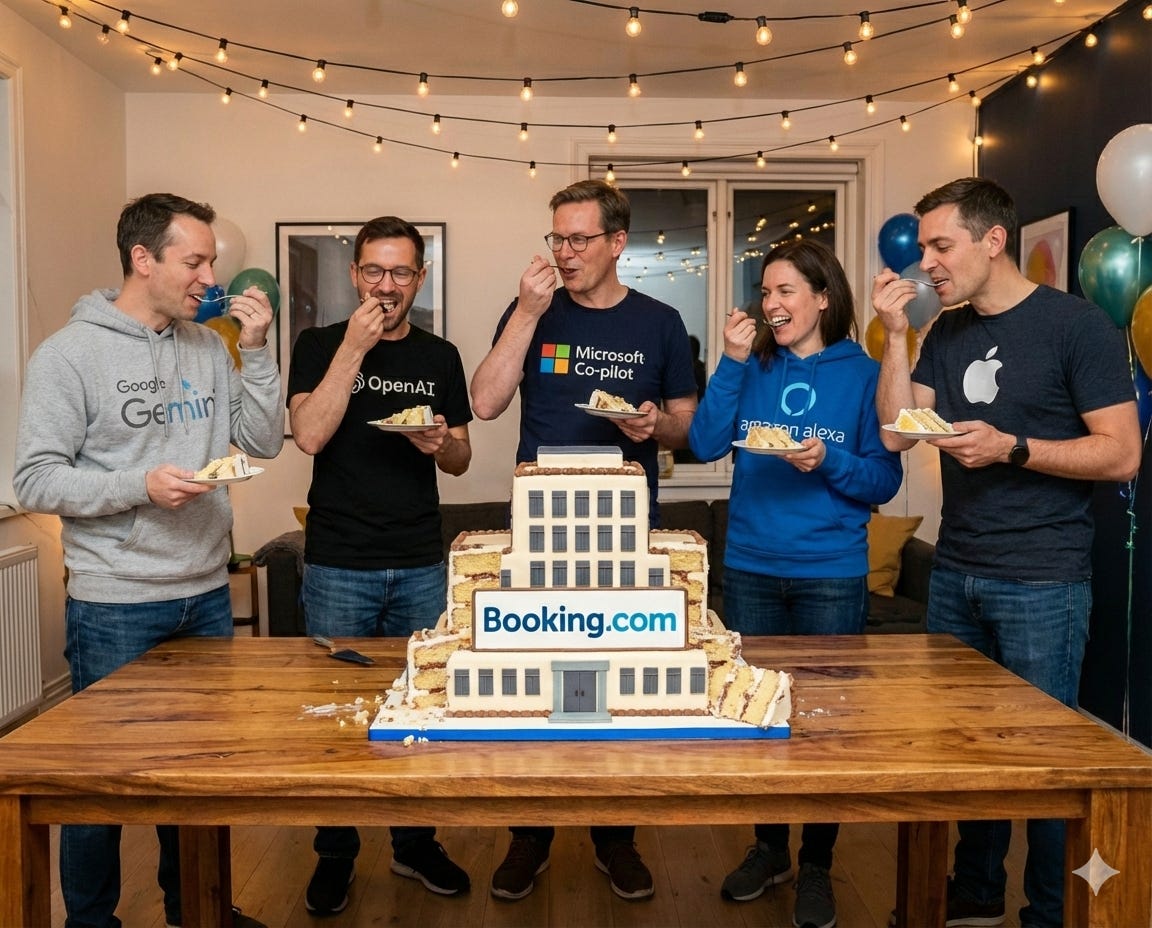
AI Platforms are coming for Booking’s Cake
It’s been the recent talk of the industry. We’ve been sensing it for a while, and now it’s getting clearer: AI is slowly but surely disrupting online travel discovery, search and possibly booking. Markus Busch recently broke this down in one of the better hotel industry pieces I’ve read lately. And Thomas Reiner has an excellent take as well. Here’s my take (which is a slightly more detailed version of the post I shared).
Some data points (in no particular order):
OTA search remains largely unchanged and inefficient. Discovery is still based on filters and ranked lists, resulting in choice overload rather than decision support. (advantage to AI platforms)
Conversational search offers a superior discovery model. Refining intent with natural language and iterative refinement, reduces friction and cognitive load. Habits are changing. (advantage to AI platforms)
Travel is a high-cost, low-frequency purchase. Vacations represent meaningful financial risk for households. Reassuring consumers, cancellations, etc is critical. (advantage to OTAs)
AI platforms are moving into transactions. Efforts such as UCP and ACP integrate checkout and payment directly into AI interfaces. AI is a potential end-to-end travel agent. (Neutral, OTAs already have this)
Online travel is a mature e-commerce vertical. OTAs retain strong advantages in inventory depth, payments, and trust. That maturity provides resilience but limits their ability to rapidly reinvent the core discovery experience. (advantage to OTAs)
So, while the AI models aren’t ready to completely replace OTAs, they’ve got momentum. And the advantage of being all the hype, flexibility, and better interfaces. But they need to build trust for a high risk purchases, which will take a while.
What could happen next?
OTAs compete with their own AI bots. They have the best data (structured, verified, and complete). But unless their AI bots are vastly better than the AI platforms, why would anyone switch? To win, they’ll need much more than just a chatbot. Maybe full itinerary planning.
OTAs become the plumbing. As I’ve written before, they could power the backend: ARI data, payment, support. AIs would become the front-end UI. After all, most AIs don’t want to deal with cancellations and refunds. Google already proved that with hotel ads.
AIs pull data from GDS instead. If GDSs review their business model and become API-first, they could leapfrog the OTAs. But they missed the internet revolution, can they catch the AI wave?
AI becomes the new metasearch. We could end up with AI just replacing metasearch. They give you options, hotels pay per click. Same model, new interface. Similar to 2 above.
AI creates a new gig economy. Outlier scenario: AI travel assistants become a thing. Not bots, but people using bots. Imagine a personal assistant for your trip. Someone you call/message who books, rebooks, cancels, and manages customer service on your behalf. Affordable because they’ve got AI help.
All of this impacts market value. If OTAs become plumbing, they’re valued like B2B platforms, not B2C giants. And while OTAs still hold strong cards (risk handling, maturity, customer trust), the user experience is turning against them.
However, paradigm shifts are hardest in stable and mature markets, not impossible, but harder, we shouldn’t underestimate the importance of confidence that customers need in case something goes wrong on one of the largest annual expenses of a household.
Let’s see if Booking keeps the cake, or ends up serving it to someone else.
• Fun exploration of clothing styles from 1980 to 2025 - Link
• Rewind MTV - amazing collection of music videos - Link
• Disney’s Missed YouTube Opportunity - Link
• Pharrell’s “Drophaus” Living Concept - Link
• Netflix and the “Short Attention Span” Plots - Link
• The OTAs of the World Infographic Remixed - Link⁺
Did you know?: The word "infographic" is a blend of "information" and "graphic." It first appeared around the 1970s, as the need for visual data presentations grew in print media and later with computers and the internet. The term describes any graphic design or artwork that expresses information visually. Defined using Lomar Dictionary⁺
This is a smart, level-headed take in a space that’s getting very loud very fast. No “OTAs are dead” theatrics, just a clear look at where the real advantages still sit and where the cracks are forming.
What really resonates is the point about trust and risk. Travel isn’t buying a hoodie. When things go wrong, people want a grown-up on the other end of the line. AI can streamline discovery, but reassurance is still a human (or at least institution-level) job.
Also appreciate the framing of OTAs potentially becoming plumbing. Not sexy, but incredibly powerful. Most platforms don’t die, they just get repositioned. The ones that survive are the ones honest enough to see that coming.
I'm wondering about legacy web companies vs AI, big time.
It's possible AI democratizes internet traffic back directly to hotel brands themselves from the cutthroat big monopolistic players: Tripadvisor, Expedia, Marriott, etc, as you note. But something fascinating about the achilles heel of being software or web based only.
If you're software *only*, it doesn't matter if you're a major player that adds AI to their website. Anyone can spin up an AI software model anywhere in the world now, so the future post-AI-bubble is physical AI and hardware. People won't be going to Tripadvisor to ask that AI, they will be using whatever hardware they use: watch, google home, smartphone, the television (the washer or fridge?).
I'm also attaching a clip that I think nails it, and it was confirmed at a product launch Tuesday, where there was a VS and AI round table. This is from a podcast that concurs: https://i.imgur.com/n1i2Ytd.mp4
They all said physical AI and hardware is the future, but the most wildly overhyped thing that doesn't make sense is humanoid robots. They in-depth explained why, and then Elon mentioned retiring Model S and X for the fremont factory to focus on his Optimus Robots. LOL
Also, a clip of the non-autonomous Optimus failing and falling when someone doesn't log out post demo. https://i.imgur.com/z4zfs8y.mp4
So the bubble is there, very much centered around legacy software and web.