


Hello,
I think a lot of people are waking up to the fact that all search is changing and the change will be faster than we expected. Discussions about if websites will still be needed are out there and there are some valid arguments. This week there were quire some discussion about attribution. So I shared my thoughts.
PS: If you haven’t filled out my survey, I’d love to have your reader feedback.
Best, Martin

Generate 50-200+ enriched MQLs
every month.
Download the brochure ➛

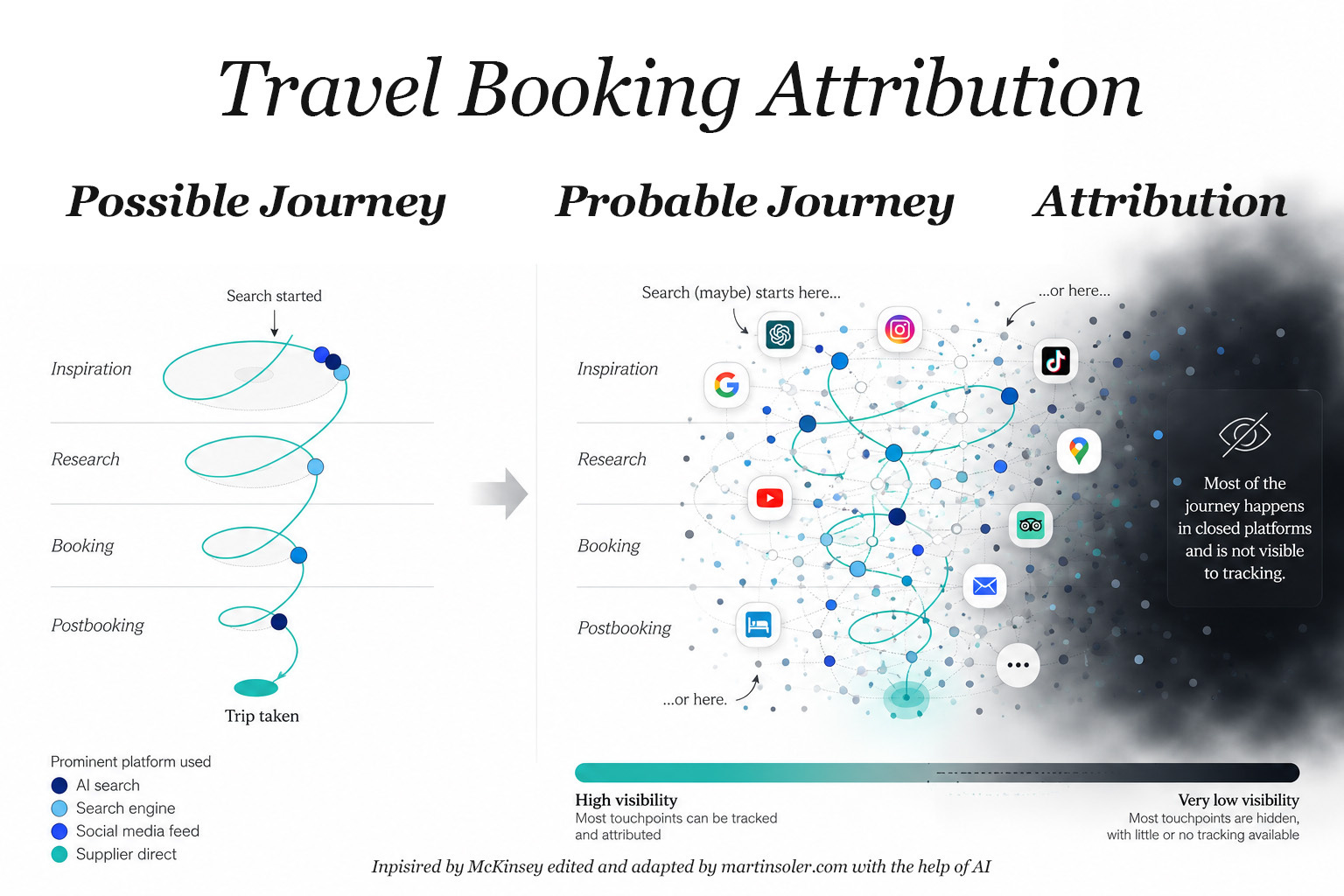
Attribution is breaking, totally
We’ve spent years trying to make marketing perfectly measurable. Some people even believe that without attribution tracking one can’t measure the success of a campaign.
And while attribution was always a sort of pseudo-science, it is about to get a lot worse. Zero-click search is real, AI is increasingly answering questions without sending users to websites. The tracking that has been disappearing for the last decade, has slowly (and soon suddenly) been disappearing. Bit by bit, the trail between someone discovering a hotel and eventually booking it is disappearing.
The good news for hotels is that people still need somewhere to sleep. Rooms still need to be booked. Demand isn’t disappearing, our ability to confidently explain exactly how someone arrived at the booking is.
Maybe AI platforms will give us brilliant new attribution tools. But between the old tracking infrastructure breaking down and whatever replaces it becoming established, we may spend a few years looking at bookings and having surprisingly little idea where some of them came from.
We’ll be going back to that sophisticated analytics tool from 1987, asking the guest: “How did you hear about us?”. Ironically, it is probably a good idea.
Tracking and attribution dependence is a problem in many marketing meetings, mostly because one side thinks it is an absolute science and the other knows it is a guesstimate at best.
Losing some attribution might force us back toward skills we should never have abandoned such as looking at patterns, using intuition, observing correlations etc. That doesn’t mean abandoning data, but rather becoming more comfortable with data being incomplete and our intelligence used to fill the gaps.
Perhaps the next generation of great hotel marketers won’t be the people with the most sophisticated attribution dashboards. They’ll be the ones who can make good decisions when the dashboard doesn’t have the answer.
Which, when you think about it, is what the good marketers have done historically for decades.
_____
Some beginner tips on how you can “attribute” your bookings/revenue to your marketing actions:
Track when campaigns start and end, and look for impact on bookings. Did you get more, or less around that time?
Are the bookings you’re getting coming from the demographic you are targeting?
Do you see similar patterns (highs and lows) in the ads and impressions vs the bookings (possibly with a delay)?
After you ran a few influencer campaigns did you see an growth in inquiries or bookings? is it different from usual patterns? (this could be weeks later)
About me: I'm a fractional CMO for large travel technology companies, and the co-founder of Pragmatik, an agency that drives MQLs through highly relevant content and distribution. You can find out more at wearepragmatik.com. Too Many Logins
Guests increasingly have to identify themselves separately for Wi-Fi, apps, casting and more. I’ve given up on casting, I just don’t use inroom TVs anymore. The passwords dilemma is real. For some time now there have been tech solutions to fix this. It would be amazing to make this a standard in all hotels.
GUEST IDENTITY
The Story of every PMS
Products start simple, become successful, then keep adding features until someone else spots the opportunity to make them simple again. Zoom, Mailchimp and every. single. PMS. But does this mean that disruption theory works in hotel tech as well? I haven’t really seen it apply to a PMS.
INNOVATION CYCLE
Rerouting Travel Discovery
Interesting data on how traffic from AI platforms to travel websites is growing. Hotels need content that AI systems can understand, but they also need websites worth visiting once the recommendation happens. But how much should one invest now, do we know what works yet?
AI TRAVEL DISCOVERY + SHORTLISTING + GOOGLE DATA
Can AI Make Travel Too Perfect?
AI travel research and booking will remove a lot of friction, some argue that this will remove some of the experience. It isn’t quite real to me that some people want that friction, but who knows.
AI TRAVEL PLANNING + INSTINCT EXAMPLE
Adding value
A lot of AI cases sell cost reduction, Seth Godin argues that the bigger opportunity is creating new value rather than just doing existing work cheaper. But we need to go through a first phase to get to the second phase.
AI BUSINESS
More on AI attribution problems
Following my column, AI creates an attribution problem, it influences a purchase without any trail. Apparently 91% of marketers believe AI discovery is changing marketing, while only 8% can track its impact end-to-end. A much longer interview on this than my column above.
AI ATTRIBUTION

The Tech Trends of 2026
McKinsey identifies 14 major technology trends spanning AI, compute, connectivity and engineering. It is a very high level view, but it’s good enough for the hotel industry.
TECHNOLOGY TRENDS
Modernization Without Ripping Everything Out
While I often advocate for hotels to change their core PMS stack, there are always options around that. As is argued here, middle-ware platforms can help here. Integration is boring compared with a shiny new platform, but boring technology that works is usually underrated.
HOTEL SYSTEM INTEGRATION
More Microdrama
Microdramas being adapted from existing TV series shows the format is starting to gain traction. Maybe all the old soap operas will have their second life. What’s interesting here is more ad formats in vertical microdrama style could be an opportunity for hotel campaigns.
MICRODRAMA ADAPTATION
Marriott’s 9-Year AI Advantage
Marriott’s long partnership with Alibaba has produced an AI agent that can book and upsell products and so forth. They’ve been sharing and working with Fliggy for 9 years now. With the super-apps in China, will we see AI integrations sooner?
MARRIOTT AI
AI Agents Need Rules
Meta’s Muse reportedly lasted only 12 days on Amazon before being blocked. Amazon stands to loose A LOT of ad revenue if agents start taking over. OTAs are probably going to similarly block agents. AI companies are working on protocols that define how agents identify themselves and access data. But will that make things easier or harder?
AGENT PROTOCOLS + BLOCKING AGENTS
Is Effort the Real Luxury?
Oura the health ring company in Finland could have created its ad set miniature city with AI, but instead hired 35 modelmakers to physically build it at one-tenth scale. In an era where generating something spectacular is becoming cheap, visible effort itself and craftsmanship might be the real luxury. Just like restaurants doing their crepe suzette at your table.
HUMAN CRAFT
• Visit Sweden for Introverts - Link
• Where to get inspiration for hospitality - Link⁺
• Visit Norway a Grumpy Musical - Link
• The Hotel Yearbook Goes All-In on AI - Link
• AI bootcamp for hoteliers - Link
Did you know: The word "attribution" comes from the Latin word "attribuere," which means "to assign" or "to give." It entered English through Old French in the late Middle Ages, keeping the sense of assigning or giving credit or responsibility. Defined using Lomar Dictionary⁺